Is the design generalist back?
Maybe. Just not in the way we remember it.
In the late 1990s, building for the web often meant doing all of it. One person worked out the structure, made the graphics, laid out the pages in tables and spacer GIFs, and got the site online.
Then the industry specialized.
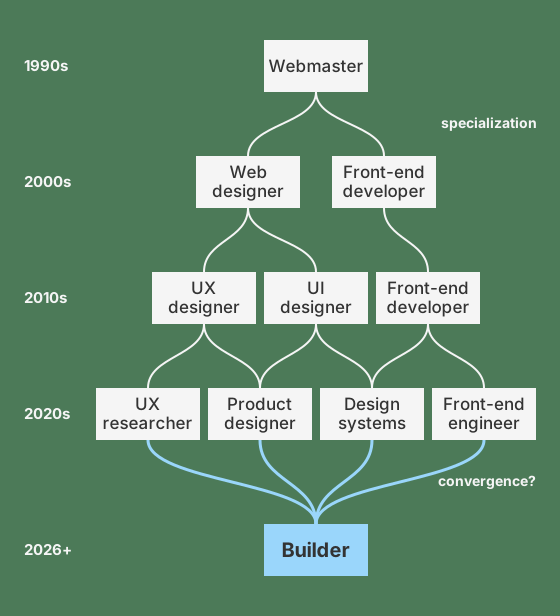
For about 25 years, products and the technology behind them got more complex, and design and development kept splitting into narrower roles.
AI is starting to push the other way.
A designer can now work in a production codebase without being an expert programmer. A developer can generate and change an interface without first becoming an interaction designer. A PM can hand over a working prototype instead of a requirements document.
Figma’s 2026 AI report is an early sign of it. In one year, the share of designers taking part in development roughly doubled, to 41%. Developers doing design work went from 44% to 60%.
There’s a push right now for the specialist: let AI cover the broad work and go deep on one thing. I think it’s the generalist.
That doesn’t mean we’re going back to the webmaster of 1998. The tools are different, the products are far more complicated, and the skills behind good product decisions haven’t gone anywhere.
But the shape is similar: one person who can get a lot further on their own, from a problem to a finished product.
What do we call that person? Product designer? Design engineer? Builder, maybe. The title matters less than how the work changes.
For years the process looked something like this:
Problem → UX → UI → handoff → code → product
More and more, it looks like this:
Problem → explore → build → evaluate → iterate
One person moves back and forth between those steps, with AI helping.
That changes what designers should practice. Some coding, sure. More screens, probably not. What I would focus on:
- Understanding the problem before reaching for a solution
- Judging whether an interaction is actually good
- Understanding systems and constraints
- Working directly in prototypes and production code
- Knowing enough about the technology to direct AI well
- Testing more ideas, since making them is cheap now
- Keeping things coherent when almost anyone can generate an interface
For a long time, specialization made it hard for one person to hold the whole product in their head. AI might make that possible again.
So is the design generalist back?
I think so.