What is Creature?
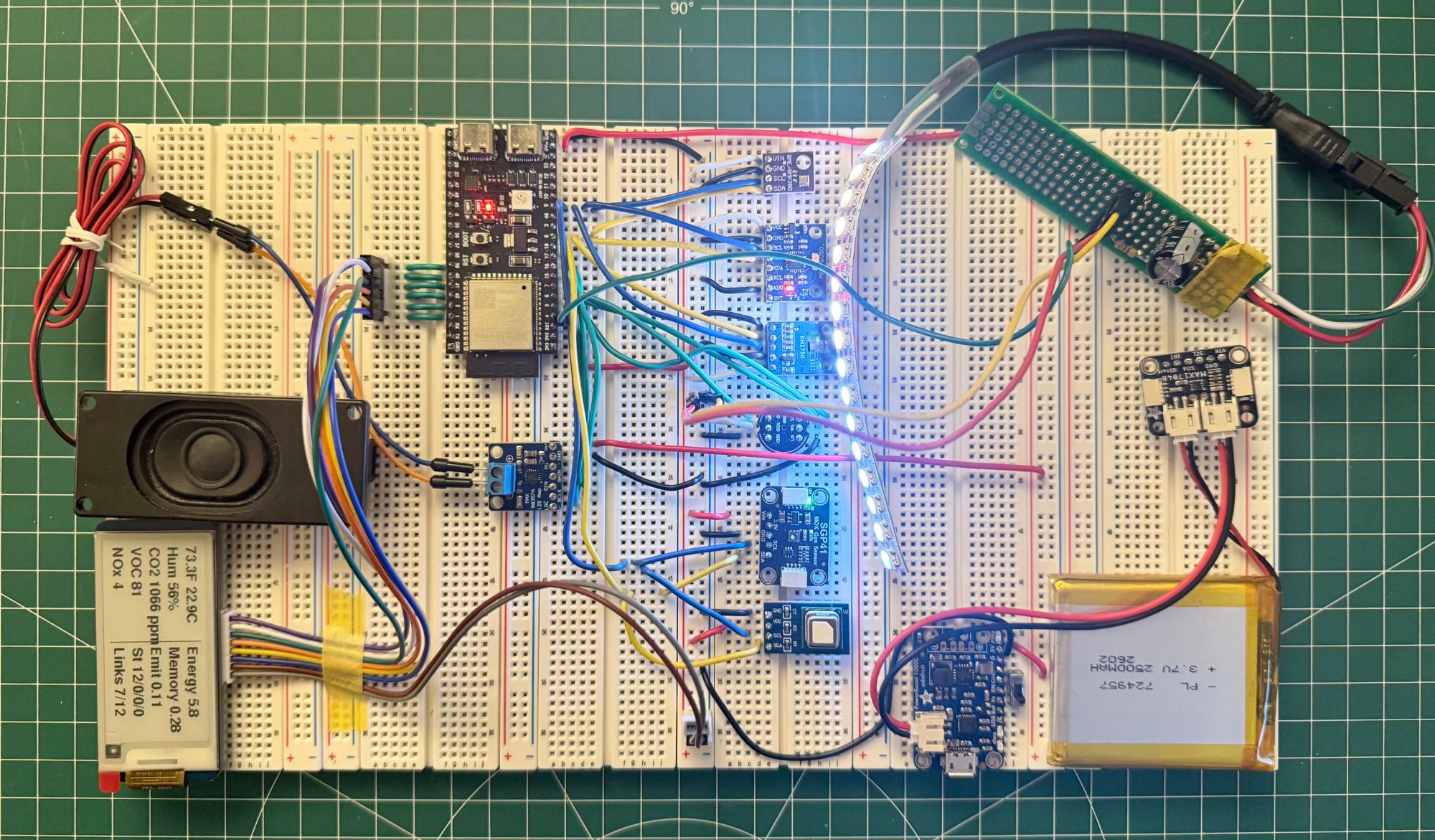
Creature is a small homemade life form built from sensors, an ESP32 chip, and a Raspberry Pi. It senses sound, light, motion, and the air in the room, and expresses itself through an RGB LED strip and a speaker.
Inside it, twelve software cells sit in a ring. Each one watches a mix of those senses. Instead of running a script, each cell predicts what it expects to sense next, and reacts when reality doesn't match. Connections between cells get stronger or weaker depending on what keeps happening together.
There is no script and no decision tree. Everything on this page is Creature's actual state right now, not a performance of one. The diagram above shows that state live. Below is a plain explanation of every term on this page, and in the log line the software prints while running.
- Sound / Light / Motion / Weather
- How much is happening right now for each sense, from 0 (nothing) to 1 (a lot). These are scaled values, not raw sensor numbers. Weather is the air: how much the CO2, the VOC index, the air temperature and the humidity have moved from their own last hour, CO2 counting most. A steady room reads near 0, an opened window jumps. (Before 15 October 2026 it was the room's temperature as a level.)
- Energy
- How much working energy Creature has in reserve, out of a maximum of 6. Activity drains it, rest refills it.
- Memory
- Short for "memory pressure" — a 0 to 1 measure of how much unresolved activity has built up. High memory pressure is one of the things that can trigger sleep.
- Emit
- How strongly Creature is currently expressing itself, from 0 to 1. This number drives both the LED strip and the speaker.
- LED
- The actual brightness value being sent to the LED strip right now.
- States
- How many of the 12 main cells are active / resting / dormant / in deep sleep, in that order. "12/0/0/0" means all 12 cells are awake and active.
- Links live
- How many of the connections between cells currently carry a meaningful strength, out of the total number of connections that exist.
- Tick
- Creature's internal clock. One tick passes every second, and the whole field updates once per tick.
- mode
- Whether Creature is currently awake or asleep.
- reserve
- Same as Energy above, shown as current amount / maximum.
- cell energy avg
- The average energy level across all 12 cells.
- fatigue avg
- The average fatigue (how worn down) across all 12 cells.
- memory pressure
- Same as Memory above.
- recent events
- How many notable moments have been logged recently.
- railed gains
- How many cells have hit the ceiling of their own internal adjustment range.
- sleep remaining
- If asleep, how many ticks are left in the current sleep cycle. Zero means Creature is awake.
- reviewed
- How many recent events got reconsidered during the last sleep cycle.
The software that runs Creature prints a line like this one every 30 ticks:
- t116880
- The tick number — same meaning as Tick above.
- in s / l / m / w
- The raw incoming sense readings this tick: sound, light, motion, weather. Same meaning as Sound/Light/Motion/Weather above.
- anchors snd / lit / mot / wth
- How active each sense's dedicated cell in the ring is right now. This can differ from the raw reading above, since the cell reacts to its own prediction, not just the raw number.
- emit
- Same as Emit above.
- led
- Same as LED above.
- E
- Same as Energy/reserve above.
- M
- Same as Memory/memory pressure above.
- states
- Same as States above.